


Tesla's once-bullish tone on robotaxis shifts
Tesla's once-bullish tone on robotaxis shifts

By Chris Kirkham and Akash Sriram Thu, July 23, 2026 at 5:43 PM UTC
0
By Chris Kirkham and Akash Sriram
LOS ANGELES, July 23 (Reuters) - A year ago, Tesla CEO Elon Musk said the company's robotaxi network would expand at a "hyper-exponential rate" and be available to half the population of the U.S. by the end of 2025.
On Wednesday's earnings call, Musk and his executive team struck a more guarded tone as they fielded analysts' questions about a slower-than-expected rollout. The robotaxi update likely contributed to a steep selloff in Tesla shares on Thursday.
Tesla's stock price, which had fallen nearly 17% this year as of last close, was down 13% in afternoon trading, set for its biggest percentage drop in more than a year.
"More is needed to show that Tesla's capabilities are inflecting" on robotaxis, Barclays analysts said in a note, adding that Tesla provided no new expansion targets and "hasn't met previously laid out targets."
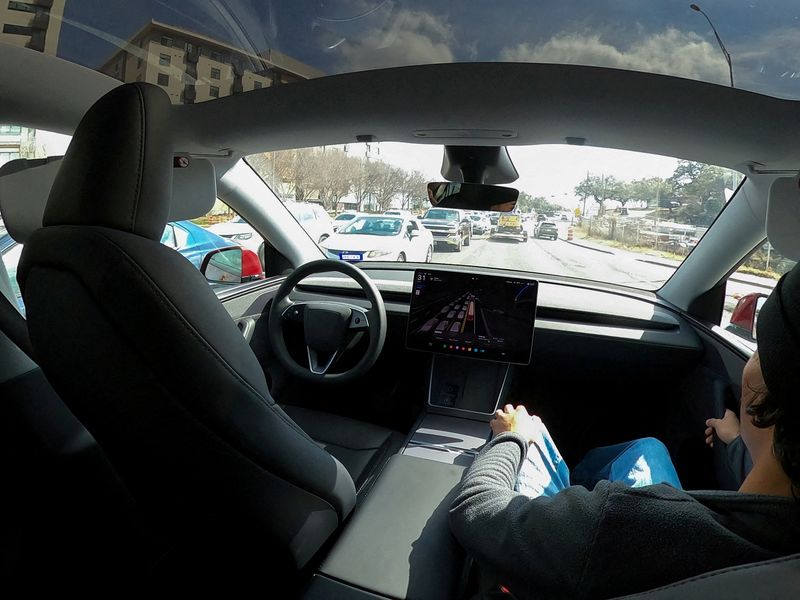
Since launching a small robotaxi pilot in Austin in June 2025, Tesla has expanded to only a handful of other cities, in Texas and Florida, with service often limited to outlying areas.
Before the Austin launch last year, Musk talked about how Tesla's technology is "a general solution that works anywhere," in contrast to the more deliberate, city-by-city approach of Alphabet's Waymo, the U.S. leader in driverless taxis.
On Wednesday, Musk and other executives delved into the specific details of scaling up robotaxi service in individual cities.
"Regulatory situations are different city by city," said Lars Moravy, Tesla's vice president of vehicle engineering. "The reason we're expanding city by city is to make sure that we're meeting all of those one at a time."
CFO Vaibhav Taneja added, "there are different kinks ... not just on the software front, but on the operations front, that we're trying to tackle."
He said the company wants to "sort these things out in a smaller fleet in a controlled manner" before going "really high in terms of deployment."
Wells Fargo analyst Colin Langan asked why the number of vehicles is still "in the dozens as opposed to hundreds." What is the "roadblock to start adding more vehicles on the ground?" he asked.
Advertisement
Tesla Vice President of AI Ashok Elluswamy said that even with a few vehicles, "you can get a lot of miles out of them."
He said the growth in robotaxi miles driven is "literally exponential. Just, it's in the early part of the exponential. That's why it's hard for others to comprehend."
Musk on Wednesday's call reiterated that Tesla is balancing the pace of the expansion with safety. "We want to grow as fast as possible with robotaxi, without harm to anyone."
Tesla said paying customers have traveled 2.5 million miles (4 million km) in its robotaxi service, including 380,000 miles in rides without an in-vehicle safety monitor.
Tesla's unsupervised robotaxi miles remain well below the more than 220 million autonomous miles driven by Waymo through the end of March, underscoring the lead Alphabet's self-driving unit holds in commercial deployment, Forrester analyst Paul Miller said.
Investors have valued Tesla on the promise that robotaxis and its Optimus humanoid robots will one day become its primary revenue drivers. The stock trades at more than 166 times forward earnings estimates, far above the multiples of traditional automakers and Big Tech companies.
In an investor presentation in January, Tesla said that its robotaxis would expand to seven metro areas by the end of June: Dallas, Houston, Phoenix, Miami, Orlando, Tampa and Las Vegas.
Up until Tuesday, Tesla had only launched in three of those cities: Dallas, Houston and Miami, with service limited to outlying sections of Houston and Miami.
The company announced on Tuesday that it was "now in Tampa and Orlando," following several analyst reports ahead of earnings that mentioned the slow expansion.
But the service areas in those cities, like Miami and Houston, were limited to less-trafficked neighborhoods outside the city centers.
Reuters tested out the robotaxi service in the weeks after the Dallas and Houston launches and found long wait times, with sometimes no availability at all.
(Reporting by Chris Kirkham in Los Angeles and Akash Sriram in Bengaluru; Editing by Mike Colias, Saumyadeb Chakrabarty, Rod Nickel)
Source: “AOL Money”
