


Secrets, lies and a shock A-list cameo: how You Can See Everything became the film of the year
Secrets, lies and a shock A-list cameo: how You Can See Everything became the film of the year

Adrian Horton Mon, October 19, 2026 at 4:57 PM UTC
0
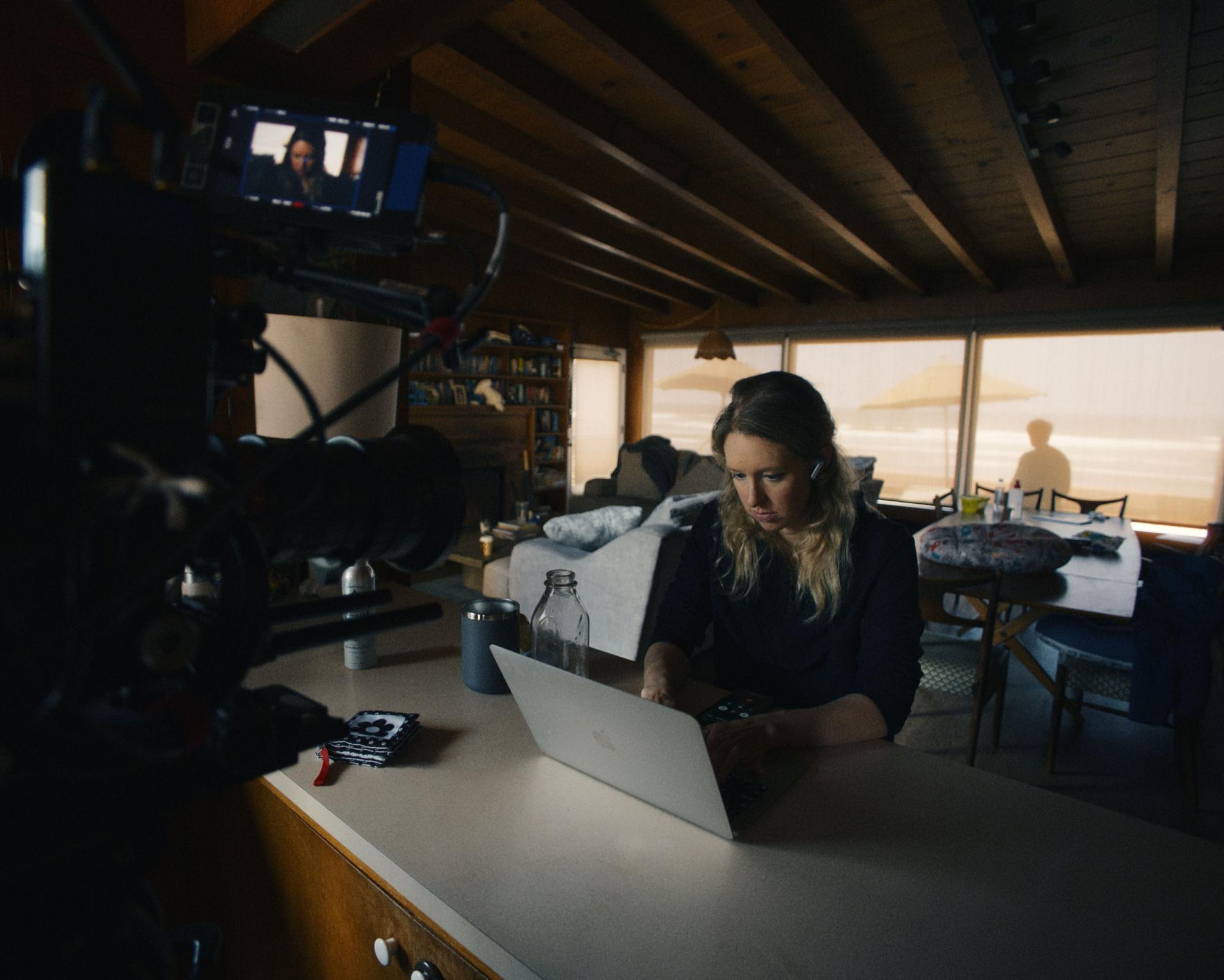
A still from You Can See Everything.Photograph: A24Nathan Fielder’s secretive Elizabeth Holmes documentary has become a sold-out smash hit and might make Oscars history Spoilers ahead
If there is one moment that sums up You Can See Everything, the new A24 documentary on Elizabeth Holmes that until this weekend was shrouded in spoiler-averse secrecy, it is, perhaps surprisingly, the one everyone already knows: co-director Nathan Fielder, the droll comedian known for deadpanning subjects into submission, sitting eye to eye with Holmes, the unblinking fabulist of Theranos infamy. In tight zoom, saturation turned up – Fielder’s arched brows and Holmes’s oceanic blue eyes as stark as two magnetic poles – he asks her: “Are you being real right now?”
Related: ‘You can’t make this stuff up’: why we remain fascinated by Elizabeth Holmes
That question hangs over much of the colossal three-hour movie, particularly a claustrophobic first half that has made headlines since the film’s existence was announced in September. That first half – essentially, the only part of the movie anyone respecting spoiler guidelines and/or the theatrical experience could talk about – takes place entirely in 2023, when Fielder and his co-director Lance Oppenheim, along with a small crew, embedded with Holmes, her husband, Billy Evans, and their two small children in the run-up to her prison sentence for fraud. We watch as Fielder, over a few surreal weeks in a beachfront rental, attempts to puncture Holmes’s indomitable facade of faultlessness. It’s not exactly comedic, this chess game between three norms-ignoring people, but it can be quite funny: TV’s grand illusionist, an absurdist auteur who will go as far as actually obtaining a 737 pilot’s license for the bit, stymied by a world-class fabricator, with her poorly dissembling husband on the side. This section resembles, in feel, the pull of internet wormhole: the closer you zoom in on a subject, without outside context, the more sense devolves. Was Holmes “being real”, for instance, when she told Fielder, with seemingly complete sincerity, that she has never told a lie in her life? Or when she continued to insist, despite plain reality, that Theranos devices could perform 1,000 diagnostic tests?
It’s at once astounding how many people took her seriously, given how obviously mendacious she and her husband appear, and also understandable: the more time you spend with her – the more time you spend watching Fielder spend time with her – the more magnetic the force of her delusions. Or is it manipulations? Or both? There is no one correct read on what, exactly, she’s thinking. “I know what you’re feeling,” an obviously irritated Evans tells Fielder after he bristles at Holmes’s indistinction between the meanings of can perform and could theoretically perform 1,000 diagnostic tests. It is a relief, and one of the best lines of an extremely rich text, when the comedian immediately shoots back with his own irritation: “No, you don’t.” The fundamental unknowability of another person, even a known liar, is fascinating, but also its own dead end.
If the first half had been released as a standalone film, it would probably have generated some attention and then faded as an artefact of a particular era of Silicon Valley celebrity, a briefly fascinating but inconclusive stunt. But luckily for us – and the theatrical box office, where You Can See Everything had the most successful opening weekend for a documentary in over 20 years – Fielder and Oppenheim kept filming. You Can See Everything is, essentially, two films in one: an elevated true crime documentary, and then an experiment unraveling the preconceptions of a documentary. It’s the back half of this immense movie, which picks up in 2025, after Holmes has spent some time in prison, makes You Can See Everything the film of the year – a formally ambitious feat that not only pushes the boundaries of nonfiction cinema but speaks to our destabilizing present of endless, inescapable manipulation.
Advertisement
There’s a reason You Can See Everything currently holds a rare close-to-perfect score on Rotten Tomatoes, is among the highest-rated films all time on Letterboxd and has solid odds to become the first doc to ever be nominated for a best picture Oscar. In the second half of the movie – stop now if you haven’t seen – Fielder recruits a shockingly game (and possibly awards-worthy) Amanda Seyfried, star of The Dropout, the 2022 Hulu series on the Theranos debacle. At first, it seems as though Seyfried is participating in her own stunt: how funny and improbable, to see the actor who won an Emmy for playing Elizabeth Holmes watch footage of Holmes watching Seyfried play Holmes. Two very famous people, confronted by famous representations of themselves. Whose reaction is genuine?
But Seyfried thrillingly becomes part of the very Fielderian pursuit of emotional truth through arcane artifice. Borrowing logic from his groundbreaking HBO series The Rehearsal, Fielder inserts Seyfried into an escalating series of re-enactments, trying to wring some clarity out of his real interactions with Holmes, then out of their own reactions to the simulations. Seyfried oscillates between a conviction that The Dropout was a work of fiction grounded in fact, and that its liberties may have violated another person. Never have I seen an actor really dig into what it means to play a real person like Seyfried here, grappling with her various responsibilities – to Holmes the person, to Holmes the character, to story, to facts, to herself – in real time, shifting with each new piece of info or tilt of perspective.
The Dropout, for what it’s worth, was the best of a series of scam shows from 2022 that tried to turn the rise and fall of inflated 2010s tech companies such as Uber or WeWork into entertainment. (One of the film’s best punchlines is simply observing that Evans, with his “LASERS” license plate and obsession with a new Theranos “device”, continues to push Theranos 2.0 … at a WeWork). You Can See Everything coincidentally arrives amid a new wave of Hollywood attempts to make sense of tech world, from Aaron Sorkin’s dreadful The Social Reckoning to Luca Guadagnino’s OpenAI film Artificial to Alex Gibney’s colossal doc Musk, that feel insufficient to the magnitude and lunacy of the moment. By being neither bound to representation nor straightforward journalism, You Can See Everything gets to what we might call the “emotional truth” of this era – and not just because Evans, a professed Charlie Kirk fan seemingly radicalized by his Musk-owned X timeline who commissioned an AI hologram of his wife, emerges as a very 2020s villain, a tech bro with a possible drug problem and a god complex. Layer by layer, Fielder and co deconstruct the underpinnings of their storytelling, from Evans’s original deal to profit from the film to his possible loyalty toward a woman he has evident chemistry with. Truth, in fact, is dependent on what you’re shown.
Related: You Can See Everything review – Nathan Fielder’s Elizabeth Holmes doc is a modern masterpiece of deceit
This is the pinnacle of Fielder’s longstanding effort to invert assumptions of “reality” on screen. A former producer on Canadian Idol, he’s a student of reality television, a misnomer we readily accept: of course, we know, there is no true reality on TV. But documentary tends to court the benefit of the doubt, as if their presentation did not reflect the makers’ own biases and motivations. The joke is in the title; You Can See Everything is itself a lie – we cannot. Choices are made, things are not shown. Omniscience is impossible.
But we are, in this advent of AI, training to scan everything as manipulated. “Are you being real right now?” applies as much to celebrity bodies as to meme-motivated foreign wars as to the Instagram dog videos sent by my mom as to what, exactly, is going on with Elizabeth Holmes. We’re in uncharted waters now, the type best navigated collectively – such as with a theater full of other people, attempting briefly to make sense of the nonsensical, working with material delivered by the biases and motivations of other people, all vying for our attention. At what point, in this hall of mirrors, do you trust? I emerged from You Can See Everything unnerved: you maybe never know, but you still have to try.
Source: “AOL Entertainment”
