


Oil is nearing prewar prices. Why hasn’t gasoline followed suit?
Oil is nearing prewar prices. Why hasn’t gasoline followed suit?

Rachel Frazin Sat, June 27, 2026 at 6:10 PM UTC
0
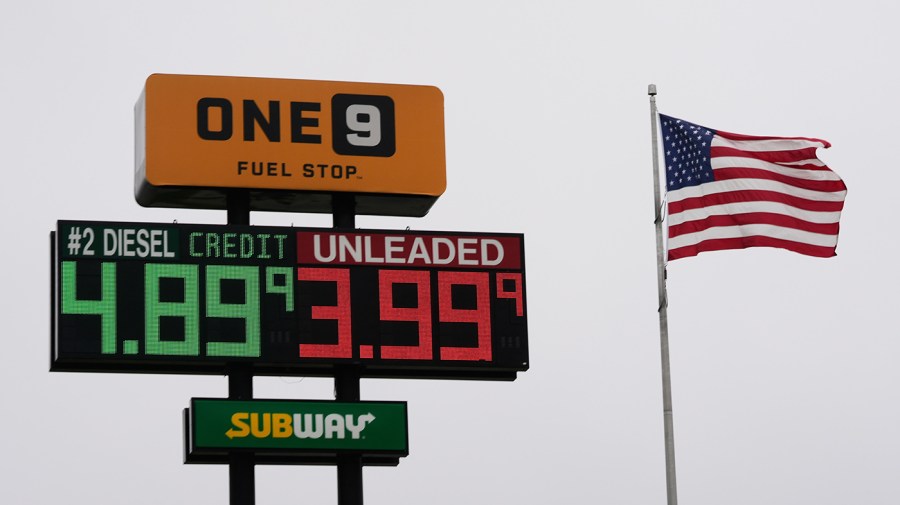
Oil is nearing its prewar price after the U.S. and Iran agreed to a memorandum of understanding (MOU) intended to end the conflict, but gasoline prices remain significantly elevated.
While President Trump has blamed Big Oil for price “gouging,” analysts say it’s individual gas station owners that are slow to lower fuel prices.
“The public is mad at the major oil companies because gasoline prices have not fallen as fast as the price of crude oil. … Their anger is misplaced,” Andy Lipow, president of Lipow Oil Associates, said in an email to The Hill.
“The oil companies own less than 5% of the service stations but their brands are sold at most of them. They should be mad at the local gasoline service station owner. They are making lots of money,” he said.
Oil prices — and therefore gasoline prices — skyrocketed over the course of the war with Iran, with the national average gasoline price clearing $4.50 per gallon earlier this year.
That’s because Iran was able to shut down the Strait of Hormuz, a key oil shipping lane through which about a fifth of global oil consumption typically flows.
A key tenet of the MOU is to allow the free flow of ships through the Strait of Hormuz, thought that in itself has been a difficult proposition to keep. Iran at the end of the week fired on a ship it argued was not going through the proper route, an effort to assert its authority over the waterway. The Trump administration responded by firing on Iran on Friday night.
As of Friday, before the latest U.S. military action, the U.S. benchmark West Texas Intermediate crude oil was trading at about $69 per barrel, virtually all the way back down to its prewar price of about $67.
However, gasoline prices were still elevated — averaging $3.90 nationally Friday, according to AAA, up nearly $1 from the price in late February.
“There’s an adage that retail prices ‘rise like a rocket, fall like a feather,’ and this is true, but it’s also true that retail prices, even though they rose very fast at the start of this war, they still didn’t rise as fast as crude prices did,” said Rob Smith, director of global fuel retail at S&P Global Energy’s Refining and Marketing group.
“Retail operators were squeezed in terms of their margin in April, so there is a need to recoup that margin — to average it out,” he said.
Another factor in the mismatch is low corporate gasoline inventories, said Claudio Galimberti, chief economist at Rystad Energy.
“We are in the middle of the driving season, and therefore demand is very high,” he said, adding that since the world is coming out of a prolonged disruption “inventories have been going down everywhere in the world.”
Trump raged at the oil industry — something that met pushback from companies he’s usually aligned with.
Advertisement
“The big Oil Companies are not dropping their price at the pump commensurate with the sharply lower prices they are paying for Oil,” Trump wrote in a post on Truth Social.
“In other words, customers are being ‘gouged,’” he added. “I have instructed the DOJ [Department of Justice] to immediately start looking into this. Gasoline prices better start going down a lot faster than what I’m seeing!”
A major oil industry lobbying group, the American Petroleum Institute (API), pushed back on Trump in a written statement.
“Gasoline prices don’t move in lockstep with crude oil, especially during a major global disruption that is still affecting supply, refining and inventories,” API spokesperson Bethany Williams said.
Meanwhile, Chevron Chief Financial Officer Eimear Bonner told CNBC this past week that “it’s going to take time” for prices to come down.
“There is a lag between … reductions in oil prices, and when that shows up at the pump, but we expect that prices will come down as things continue to normalize,” Bonner said.
According to the National Association of Convenience Stores, most gas stations are small businesses, with about 55 percent being single-location operators. According to the API, fewer than 5 percent are owned by major oil companies.
Smith also cast doubt on whether gouging was going on.
“The U.S. retail gasoline market is so incredibly fragmented in terms of ownership that it’s very difficult for there to be any kind of coordinated effort,” he said.
“Given that fragmented nature, and how competitive it is — price signs are everywhere … there’s intense pressure on pricing and margins. It’s very difficult to do any kind of coordinated gouging,” he added.
In the meantime, however, the still-elevated gasoline prices are still hitting low- and middle-income Americans hard.
“For low- and even many middle-income households living paycheck to paycheck, an additional $100 a month in energy costs is significant. Families don’t simply absorb those increases, they are forced to make difficult tradeoffs,” Mark Wolfe, executive director of the National Energy Assistance Directors Association, said in an email.
“Lower-income households are likely to take on additional credit card debt just to pay for gasoline and heating. Middle-income families are more likely to cut discretionary spending, including dining out, vacations, clothing purchases, and other consumer spending that supports local businesses,” he added.
Copyright 2026 Nexstar Media, Inc. All rights reserved. This material may not be published, broadcast, rewritten, or redistributed.
For the latest news, weather, sports, and streaming video, head to The Hill.
Source: “AOL Money”
