


Earthquake warning issued for 159 million Americans as weather event could rock the nation
Earthquake warning issued for 159 million Americans as weather event could rock the nation

Hannah Broughton Mon, August 10, 2026 at 12:12 PM UTC
555
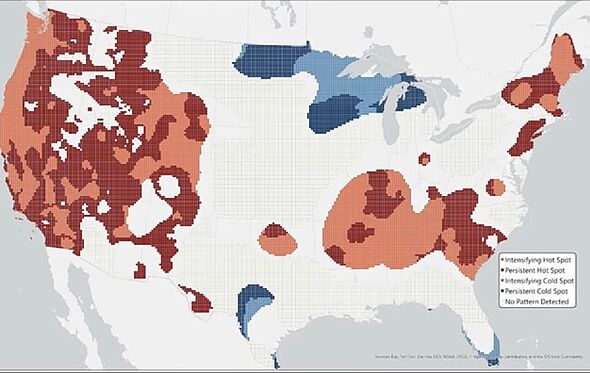
The West coast is known to experience more earthquakes than the East (Image: National Seismic Hazard Model)
Half of the people across America could face "very strong" earthquakes, with the potential to damage buildings, a new study predicts.
According to research, 159.2 million people live in regions at risk under the latest U.S. Geological Survey (USGS) hazard model. This marks an increase from 111.8 million in the previous model's version.
Earthquakes are already extremely common in the USA, with thousands occurring each year, although most do not pose a major threat. This new assessment estimates that 47.3 million homes and $25.6 trillion in buildings could be at risk. It comes after the late Professor Stephen Hawking predicted the exact date of the apocalypse before his death.
Man who 'died' for six minutes shares terrifying vision of what happens after death
Map reveals 10 safest countries to survive nuclear war amid WW3 fears
The USGS survey says that those who are exposed to the lower level of "strong" shaking then rise to approximately 234 million, which could still cause destruction.
The threat has also increased in the New Madrid Seismic Zone in the central U.S., and even areas as far as New York, Atlanta, and St. Louis are listed as vulnerable to earthquake disruption. There is also the potential for neighborhoods to be cut off from hospitals, while emergency crews and traffic could be heavily impacted, resulting in a catastrophic situation.
While the survey does not indicate that earthquakes are more frequent, improved scientific models show that more people, homes, and infrastructure are at risk than previously thought.
Advertisement
What happens when the shaking begins depends not only on the strength of an earthquake but also on the number of people, buildings, and vital services in its path, and on how well they can cope with the earthquake. This, in turn, determines the final scale of the disaster.
Therefore, if an earthquake strikes a lower-hazard city with vulnerable buildings and extensive vital infrastructure in constant use, it could face greater disruption than a more earthquake-prone region that has already invested in buildings that can withstand quakes.
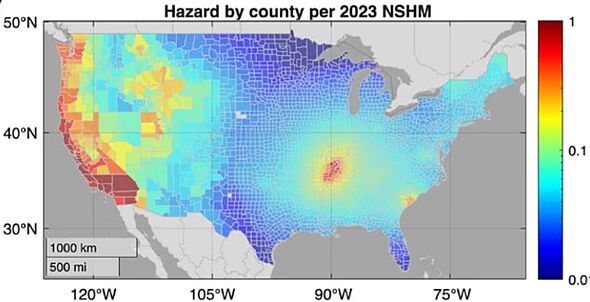
Some Americans could be at more risk than previously thought (Image: National Seismic Hazard Model)
To investigate this further, the researchers looked at 600,000 highway bridges with a combined replacement value exceeding $1.5 trillion. All of these bridges together can carry 4.5 billion individual vehicle trips each day, which makes them an essential part of travel and emergency services.
The risk was assessed, in part, by calculating the average annual number of vehicles that would be unable to use a bridge after earthquake damage. The 6,000 bridges ranked within the highest one percent for hazard had an estimated replacement value of $31 billion, while those that fell into the highest one percent for risk were worth around $74 billion.
The results showed that looking only at a map of earthquake probability often provides an incomplete picture of how much risk a community faces.
According to the USGS, one of the 10 most powerful earthquakes ever recorded struck Alaska in 1967, measuring 8.7 on the Richter scale. It generated a tsunami reportedly 35 feet high, causing $10,000 in damage, which would be worth around $100,000 today.
It comes as a terrifying hidden 'fault line' could unleash armageddon in specific US states.
Source: “AOL Breaking”
