


Billionaire Stanley Druckenmiller May Have Just Repeated His "Big Mistake" With Nvidia -- This Time With a Chip Stock That Rose 300% in the First Half of 2026
Billionaire Stanley Druckenmiller May Have Just Repeated His "Big Mistake" With Nvidia -- This Time With a Chip Stock That Rose 300% in the First Half of 2026

Adam Spatacco, The Motley FoolThu, August 20, 2026 at 8:32 AM UTC
0

Key Points -
The billionaire's investment firm, the Duquesne Family Office, initiated a position in Micron stock during the first quarter.
By the end of the second quarter, Druckenmiller had completely exited that stake.
Micron stock gained more than 300% during the first half of 2026.
10 stocks we like better than Micron Technology ›
&&
Stanley Druckenmiller is one of the most closely followed investors in modern financial history. After his extraordinary run managing the Quantum Fund alongside George Soros, he now runs the Duquesne Family Office. Investors pay close attention to Druckenmiller's moves because he has a history of identifying major macroeconomic shifts early and sizing positions aggressively.
Yet even legends make blunders. Druckenmiller, for example, has openly called his decision to sell Nvidia(NASDAQ: NVDA) when he did a "big mistake," noting that the stock continued climbing long after he exited his position. This admission raises a similar question: Did he just make a similar error with his early exit from Micron Technology(NASDAQ: MU)?
Missed Nvidia in 2009? This Rare Signal Is Flashing Again.In 2009, a "Double Down" signal flashed for a little-known chipmaker called Nvidia. For the first time in years, that same "Total Conviction" signal is flashing for a company 1/100th the size of Nvidia. Continue »
&&
Image source: Getty Images.
Breaking down Druckenmiller's Micron trade
Duquesne initiated a position in Micron during the first quarter of 2026, acquiring 23,400 shares. The firm's most recent 13F form, filed with the Securities and Exchange Commission last week, reveals that sometime in the second quarter, Druckenmiller completely closed that position. While the exact entry prices and trade dates remain private, Micron's broader price action is clear. During the first six months of the year, Micron stock gained more than 300%.
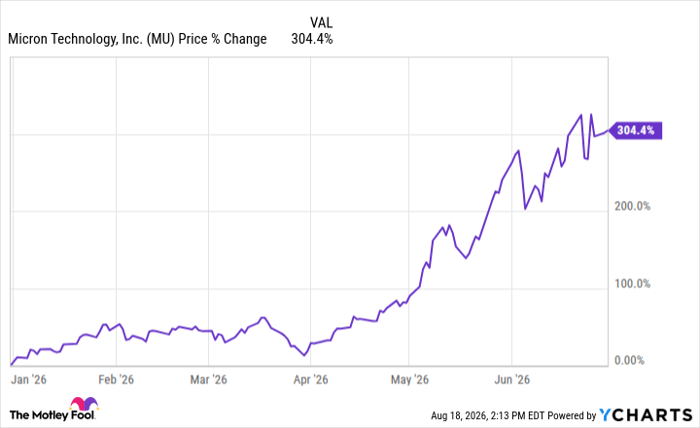
MU data by YCharts.
In that same stretch, the memory-chip maker entered the trillion-dollar club -- a milestone also achieved by peers SK Hynix and Samsung. The scale of this move turned Druckenmiller's modest stake in Micron into a multibagger in just a matter of months.
What may have prompted Druckenmiller to sell Micron stock
Micron's surge has been fueled by unprecedented demand for high bandwidth memory (HBM) and advanced DRAM solutions that feed data into the training and inference engines of artificial intelligence (AI) models. Memory sits at the center of the hyperscaler compute build-out -- without adequate data storage capacity and bandwidth, even the most sophisticated accelerators would frequently have to sit idle while awaiting information to process.
Micron has been booking record revenues and expanding its margins to sky-high levels, and the new multiyear supply agreements it is inking with its large clients appear to be rewriting the narrative in the memory market away from its traditional boom-and-bust cycle. Against this backdrop, Druckenmiller's decision to sell into strength might appear to have been premature.
Smart investors will realize that there are several practical considerations that support taking gains now, however. Micron and its rivals are racing to bring new fabrication lines online. Memory markets, however transformed, are still going to respond to capacity additions and changes in the supply-and-demand dynamic. This makes a valuation that expanded threefold in a single quarter vulnerable to significant mean-reversion risk sooner than some investors may anticipate. By locking in profits, Druckenmiller reduced his exposure to any near-term inventory digestion or competitive response in memory supply chains.
Was history repeating?
It's hard to dismiss the parallel between Druckenmiller's early exit from Nvidia and his decision to sell Micron. Both companies rode the AI wave, each delivered a triple-digit-percentage gain over a short period, and Druckenmiller exited both stocks while their momentum remained strong.
Advertisement
A more thorough comparison favors a different conclusion, though. Nvidia's competitive advantages are supported by its ecosystem -- a moat that has proven extraordinarily durable. The tight integration between the company's GPU architecture and its widely used CUDA software platform has locked developers into its ecosystem in a real way -- creating switching costs that pure-play memory producers can't replicate.
Memory remains fairly a commoditized product, even at the high end. This is one reason why historically, after every boom cycle, every player in the space eventually feels the same headwind when supply catches up to and exceeds demand. Druckenmiller's exit from Nvidia occurred after the stock had already multiplied and its valuation looked extreme by traditional metrics.
With Micron, the time frame around its valuation expansion was much shorter. Moreover, the structure of the memory industry differs enough from the advanced processor market to justify investing with caution. Taking profits after a parabolic advance does not automatically mean Druckenmiller made an error.
In the long run, history may prove that Druckenmiller sold Micron too early. For now, his decision rests on some distinguishable logic compared to Nvidia rather than an identical misjudgment. In an AI market defined by rapid narrative shifts, the greater risk might have been refusing to bank abnormally high gains when given the opportunity.
Should you buy stock in Micron Technology right now?
Before you buy stock in Micron Technology, consider this:
The Motley Fool Stock Advisor analyst team just identified what they believe are the 10 best stocks for investors to buy now… and Micron Technology wasn’t one of them. The 10 stocks that made the cut could produce monster returns in the coming years.
Consider when Netflix made this list on December 17, 2004... if you invested $1,000 at the time of our recommendation, you’d have $419,408!* Or when Nvidia made this list on April 15, 2005... if you invested $1,000 at the time of our recommendation, you’d have $1,348,694!*
Now, it’s worth noting Stock Advisor’s total average return is 966% — a market-crushing outperformance compared to 213% for the S&P 500. Don't miss the latest top 10 list, available with Stock Advisor, and join an investing community built by individual investors for individual investors.
See the 10 stocks »
*Stock Advisor returns as of August 20, 2026.
&&
Adam Spatacco has positions in Nvidia. The Motley Fool has positions in and recommends Micron Technology and Nvidia. The Motley Fool has a disclosure policy.
Source: “AOL Money”
